Newsroom / IERTEC
3D printing
This story is not about 3D printers. It is about a device that prints text and images on a sheet of paper and has become an everyday home or office appliance, often used without anyone realising how important it is: the laser printer.
This story is not about 3D printers. It is about a device that prints text and images on a sheet of paper and has become an everyday home or office appliance
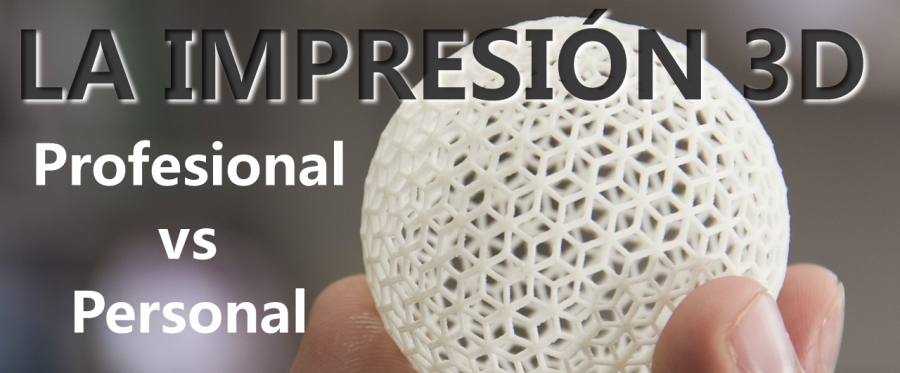
This story is not about 3D printers. It is about a device that prints text and images on a sheet of paper and has become an everyday home or office appliance, often used without anyone realising how important it is: the laser printer.
The laser printer was invented at Xerox in 1969 by researcher Gary Starkweather, who had an improved printer by 1971 and integrated it a year later into a fully functional network printing system.
The first laser printer designed for office use appeared in 1981: the Xerox Star 8010. Although highly innovative, the Star was an expensive system ($17,000) that only a small number of companies and
institutions could afford.
Today, 30 years later, the cost of printing has fallen by two orders of magnitude: a SOHO (small-office home-office) colour inkjet printer costs less than $50, while a basic monochrome laser printer costs $100 or less. Laser printers (including colour models) are therefore quite popular in homes, where everyone can benefit from their excellent performance, speed and print quality. Some people think 3D printers are following the same path, but faster.
3D technologies and professional 3D printers
3D printing2 (also called additive manufacturing) is the process of making a solid, three-dimensional object of almost any shape from a computer-generated digital model. 3D printing uses an additive process in which successive layers of a material are deposited in different shapes. This distinguishes it from other manufacturing techniques that usually remove material by cutting or drilling (subtractive processes).
Additively manufactured objects can be used at any stage of an object's life cycle, from pre-production (i.e. rapid prototyping) to large-scale production (i.e. rapid manufacturing), as well as tooling and post-production customisation applications. Today this technology is widely used in jewellery, footwear, industrial design, architecture, engineering and construction, the automotive, aerospace, dental and medical industries, education, geographic information systems and many other professional applications added to the list each year.
Various 3D printing processes were invented from the late 1970s onwards, but the printers were originally large, expensive and very limited in what they could produce. The most common 3D printing technology was Fused Deposition Modelling (FDM), invented and patented in 1989 by S. Scott Crump (pictured on the right) and commercialised by the company he co-founded, Stratasys3 (http://www.stratasys.com). It merged with market leader Objet, becoming today's largest manufacturer of 3D printers and 3D printing materials.
Fused Deposition Modelling
Although many technologies are possible for 3D printing, the most common, Fused Deposition Modelling (FDM), is the simplest: it creates complex objects from molten plastic expelled or extruded through a nozzle. The plastic (or even metal) filament is initially wound on a spool that unwinds to supply material to the extrusion nozzle, while the nozzle, the object or both move along three axes through a computer-controlled mechanism. The material hardens immediately after extrusion. Stepper motors or servomotors are commonly used for these movements and to push the filament into the extruder.
Another approach to 3D printing is the selective melting of materials in a granular bed, known as Selective Laser Sintering. This technique melts parts of the layers, then moves the working area forwards to add another layer of granules, repeating the process until the entire part has been built. The process uses unmelted material to support overhanging material and the thin walls of the part being created, reducing the need for temporary auxiliary supports. A laser is generally used to melt (sinter) the material and make it solid.
Another method is inkjet-style 3D printing. The printer creates the model one layer at a time by spreading a layer of powder (plaster or resin) and printing a binder onto the part's cross-section using a process similar to inkjet printing. This is repeated until the final layer is printed. The technology allows full-colour prototypes, overhangs and elastomer parts to be printed. It was first developed at MIT and is now exclusively licensed to Z Corporation.
Some professional 3D printers can print metal, ceramics and a variety of other materials and colours, producing quite large objects (several metres in size) at incredibly high resolution, mainly for industrial and professional uses. Naturally, they are very expensive and beyond the average person's reach.
A revolution: the personal 3D printer

The idea of moving from the professional 3D printer to something new, smaller and more affordable was first expressed in 2004 in an article by Adrian Bowyer (pictured on the right), then an academic at the University of Bath in the United Kingdom. Bowyer imagined self-replicating machines capable of printing some of their own parts themselves, so simply and easily that anyone could build them. From this simple idea, with help from a large online community, a movement of enthusiastic ‘makers’ was born: the RepRap project.
These first steps towards the practical creation of an inexpensive ‘personal’ 3D printer were possible within so-called maker culture, the modern incarnation of the community of geeks who built the first personal computers in their parents' garages. This culture is a technological extension of the do-it-yourself (DIY) spirit, with typical interests such as electronics, robotics, 3D printing and CNC tools, alongside more traditional metalworking, woodworking and crafts. Its philosophy promotes new and original technological applications and encourages invention and prototyping.
Steeped in this culture, the RepRap project set out to produce a free and open-source 3D printer whose complete specifications would be made public under an open licence (they chose the GNU General Public License), and which would have to be capable of replicating itself, at least partly, by 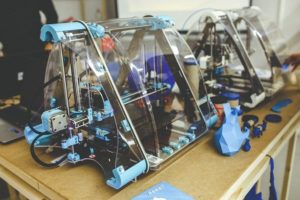 printing many of its own plastic parts to create new machines.
Because of RepRap's open-source ideal, many related projects have used its design as inspiration, creating an ecosystem of related or derivative 3D printers, most of which are also open source.
The availability of these designs means that variants of 3D printers have been, and remain, easy to invent. However, the quality and complexity of printer designs, as well as the quality of kits or finished products, vary greatly between projects. Since 2008, several projects and companies have been established to develop affordable desktop 3D printers for home use. Much of this work has been driven by, and aimed at, DIY, enthusiast and early-adopter communities, with additional links to academic and hacker communities. The cost of 3D printers therefore fell
considerably between 2010 and 2012, with many machines now costing less than $1,000 (and some even less than $500).
Professional versus personal
At this point, we should examine some practical differences between a professional 3D printer and one of its low-cost relatives:
- Whereas the former can use only one or more of the special, expensive plastic powders approved by the manufacturer, the latter can use inexpensive plastic filament (ABS, PLA, etc.) from any supplier (with a diameter of 1.75 mm or 3 mm, depending on the print head).
- A professional machine has a solid casing, generally metal (or sometimes plastic), while the frame of a low-cost 3D printer is often laser-cut plywood or printed plastic parts, and more rarely aluminium or steel.
- The software needed to operate a professional unit is proprietary (closed source), and manufacturers may organise specialised operator training courses, while software for low-cost 3D printers is mostly free and open source (not always feature-rich, but often highly customisable and evolving rapidly).
- Professional machines are controlled by proprietary industrial computers and proprietary operating systems; their low-cost counterparts make extensive use of open hardware such as Arduino, Pololu, Sanguinololu, etc. — small, very inexpensive control boards powered by open-source operating systems. Further differences could be added to this list, all pointing in the same direction: professional 3D printers always guarantee better performance and more features, at the cost of far less freedom to experiment with hardware and software, and, of course, a much higher price. Low-cost 3D printers, by contrast, are rarely suitable for professional use but can become valuable and powerful personal tools. Perhaps, like the personal computer, we can begin to call these new personal 3D printers simply P3DP or P3P. And since we are talking about the personal computer, considered by many the greatest revolution of the twentieth century, it might be interesting to review how it all began…
Plastic filaments
At present (spring 2013), two types of plastic are widely used for low-cost 3D printing, with a few others less common. Interestingly, more plastics are being developed and tested, which will offer a much wider range of physical, chemical and mechanical properties, opening the way to new applications for 3D printing. The availability of new printing materials can quickly change the filament market.
Plastic filaments are now manufactured in two standard diameters: 1.75 mm and 3.0 mm. The 3.0 mm filament is something of an older standard and is gradually being eclipsed by
1.75 mm filament, which can be pushed slightly more easily, controlled a little better and sometimes leaves fewer hanging strands on the object's sides. Nevertheless, many current printers still use 3 mm filament, which is sometimes a little cheaper than 1.75 mm.
PLA
The most common plastic filament is made from polylactic acid (or polylactide, abbreviated PLA), a biodegradable, environmentally friendly plastic derived from starch. Its melting temperature is 180–230 °C. It does not smell unpleasant when printed and its fumes are not dangerous, so it requires no special safety measures or forced ventilation.
It adheres well to the print bed at room temperature (so the more expensive heated-bed option is unnecessary), but only if the platform is covered with blue tape — another inexpensive product that must be replaced occasionally, mainly because it is sometimes damaged when the object is removed from the platform.
PLA-printed objects are sturdy but relatively brittle, and cannot be used where high-temperature resistance is required (such as some parts of the 3D printer itself).
PLA filament is quite inexpensive, averaging $30 per kg, and is generally sold in spools of 0.5, 1 or 2.3 kg (although some manufacturers also sell it by the metre). It is available in its natural colour (translucent white) or many bright, solid or semi-transparent colours, and printed objects have a beautiful smooth surface.
A special variant is soft or flexible PLA, which must be extruded at a lower temperature and very low speed; it can be used to print flexible joints, belts, tyres, etc.
ABS
The second most common filament is made from acrylonitrile butadiene styrene, abbreviated ABS: a petroleum-derived plastic used for many purposes and well known from LEGO™ pieces. Its fumes smell unpleasant and are even considered hazardous to health, so forced ventilation with fume extraction is strongly recommended when printing with ABS for long periods. ABS melts at 210–260 °C.
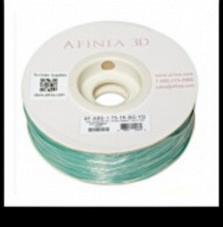 ABS costs approximately the same as PLA and is also a common printing material, despite its
more demanding requirements. An ABS object is generally printed on a heated bed (around 100 °C) covered
with Kapton tape to ensure good adhesion, adding cost and complexity to the printer (for this reason, not all printers come with a heated bed as standard, and some do not even offer it as an option). One possible solution is to print ABS on a cold bed covered with a few layers of adhesive: cyanoacrylate, hairspray or a water-based glue such as Vinavil® work well for this purpose.
However, a heated bed is recommended because it helps reduce warping when printing large objects.
ABS's advantage over PLA is that the resulting objects are stronger, less brittle and can withstand higher temperatures. ABS filament is readily available in many colours, including glitter, glow-in-the-dark,
gold and silver varieties, and even colours that change with temperature — for example, blue/green below 30 °C and yellow/green above — making objects printed with these filaments responsive to body temperature.
Nylon
Taulman produces 618 Nylon® filament, with interesting characteristics including flexibility, lightness and chemical resistance. It must be extruded at a higher temperature than PLA or even ABS (around 245 °C), but produces no fumes or odours and adheres well to blue tape. It is used to print mechanical parts requiring high breaking strength and very low surface friction. Another highly interesting potential use is printing customised prostheses and medical-related parts, as nylon is inert in the human body (although not officially FDA-approved,
at least for now). Nylon filament costs more than twice as much as PLA or ABS, the only available colour is white (natural), and the only supplier is Taulman.
PC
Polycarbonate (PC) is a very
strong, durable plastic with high optical clarity and a high melting temperature (around 270–300 °C). Although used in many industrial products (CDs and DVDs, for example, are made of polycarbonate), the first tests with low-cost 3D printers only began in 2012, and there are still few PC filament manufacturers. It is sold at a fairly high price: around $90/kg.
PVA
Polyvinyl alcohol is a water-soluble plastic polymer that can be used to print support structures for PLA and ABS objects. It dissolves easily in hot water, leaving a perfect object surface and simplifying the usually quite tedious support-removal process. The printing temperature is around 170 °C and must never exceed 200 °C. PVA filament is also quite expensive: around $90/kg.
HIPS
High-impact polystyrene (HIPS) is a plastic filament soluble in limonene. It is sometimes used to build support structures, particularly for ABS, that can be removed easily without mechanical work. Limonene is a natural solvent extracted from the peel of lemons and other citrus fruits. Printing with HIPS requires a temperature of around 230 °C. HIPS filament costs about $40/kg.
Other types of plastic LAYWOO-D3 is a recently produced wood-based filament.
Technically, it is a wood–polymer composite containing recycled wood, which can be used to print objects with a wooden appearance (even with typical growth rings). Its other characteristics are similar to PLA, but the price is very high, around $100/kg, and certain techniques are needed to change the colour of the rings. Finally, there have been
some experiments with conductive plastic, but its resistance is still too high, and a commercial product has not yet been developed.