Newsroom / IERTEC
Applications of robotics in medicine
This article provides an overview of two of the most interesting fields of robotics applied to medicine: rehabilitation robotics and surgical robotics. Within rehabilitation robotics, hand prostheses and surgical robotics are discussed in greater detail.
This article provides an overview of two of the most interesting fields of robotics applied to medicine
This article provides an overview of two of the most interesting fields of robotics applied to medicine: rehabilitation robotics and surgical robotics. Within rehabilitation robotics, hand prostheses and surgical robotics are discussed in greater detail.
The first concepts of robotics emerged in the late 1940s through the work of the man considered the father of the discipline: G.C. Devol (Nof, 1985). In 1954, Devol patented the first manipulator with memory, beginning the modern era of robotics.
In 1961, Engelberger founded Unimation, the company that began commercial production of robots for industrial use (Gibilisco, 1994). Industrial robotics has since developed a substantial market, with more than 880,000 robots operating worldwide by 2004 (Unece, 2004). Industrial robotics also stimulated applications in other areas, such as agriculture, space exploration, underwater exploration, military applications, domestic and entertainment applications, and a field with greater social impact: medical robotics.
In medicine, robotics has developed in two specific areas: assisting patients and assisting doctors. The first also has two sub-areas: firstly, devices for patient rehabilitation, which are therefore temporary tools (robots for physical and occupational therapy); secondly, devices providing permanent assistance to people with disabilities or older people (prostheses, electrical stimulation, personal assistants, etc.). Robots assisting doctors include those designed for surgery, examination, diagnosis and therapy (Krut, 2006).
As can be seen, the applications of robotics in medicine are very broad and complex. Given their social importance and prospects for future development, this essay will describe the most developed techniques in each of the two specific areas outlined above. This leads us to robotic upper-limb prostheses and robots assisting in minimally invasive surgery.
ROBOTIC PROSTHESES
Upper-limb prostheses have developed significantly since the 1960s; however, some studies indicate that around 70% of the affected population in the United States uses simple passive hooks (Yang et al., 2004). This percentage is even higher in developing countries, where often no prosthesis is used at all. According to the 2005 DANE census (Dane, 2005), our country has approximately 385,000 people with upper-limb disabilities, although the report does not specify the degree of disability in detail. Unlike these passive hooks, active prostheses use cables or, more sophisticatedly, sensors placed on part of the patient's body to move a mechanical hand with varying degrees of functionality. Detailed analyses of recent advances can be found in Lunteren et al. (1983), Shimoga (1996), Bicchi (2000) and Yang et al. (2004). However, developing a hand prosthesis that patients can feel as an integral part of their body remains far from reality. Current commercial prostheses cannot provide sufficient functionality for grasping objects, and the proposed solutions also entail a loss of degrees of freedom.
Various solutions have been proposed to address the scientific and technological challenges involved. Among the most innovative are:
DLR hand
A hand developed in Germany for teleoperation applications or autonomous tasks performed by an industrial or service robot. It has four fingers whose total movements provide 20 degrees of freedom (Borst et al., 2003).
TUAT/Karlsruhe hand
Developed jointly by Japanese and German laboratories, this hand has five fingers with a total of 20 degrees of freedom. It is driven by spherical ultrasonic motors and was designed as the hand of the ARMAR humanoid robot (Fukaya et al., 2000).
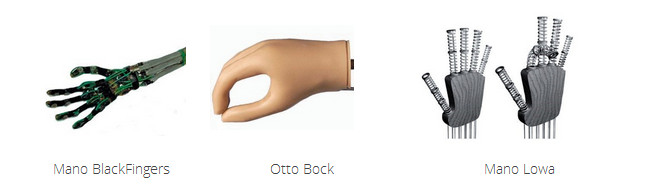
Blackfingers hand
Built in Italy, this hand consists of flexible muscles, joints made from a nylon-like material and tendons made from Teflon-coated iron cables. This complex structure provides 18 degrees of freedom (three for each finger and three for the wrist) and weighs much the same as a human hand, although its cost remains quite high.
Robotic hand with an extensor mechanism
Developed in the United States, this hand is similar to the previous one, but instead of flexible muscles it uses elastic bands extending from the forearm to move each finger. Its operation is therefore similar to that of the human hand (Wilkinson et al., 2003).
Hand incorporating proprioceptive sensors
Developed in Italy, this hand has three fingers and two motors, providing nine degrees of freedom. It incorporates position and force sensors in the two fingers to provide the complex grasping functions of a natural hand. The motors are controlled through electromyographic sensors placed on the patient's arm, making it highly adaptable to people with hand disabilities (Carrozza et al., 2003).
Iowa hand
The result of collaboration between American, Spanish and Swedish universities, this hand has four fingers composed of springs, providing a total of 15 degrees of freedom. It is designed specifically for people with hand amputations. Nevertheless, commercial prostheses remain far removed from the proposals described above, given the complexity of the task and the cost involved for the patient.
Surgical robotics
With the development of minimally invasive surgical techniques in the 1980s, surgeons no longer needed to put their hands inside the human body. Instead, specialised surgical and viewing instruments are introduced through small incisions. This procedure, called laparoscopy, causes less trauma to patients and consequently faster recovery, as well as lower costs for the social security system. However, it brought new challenges and difficulties for surgeons, including poor tactile feedback when touching internal organs, loss of three-dimensional vision, loss of wrist articulation and poor ergonomics of the instruments used (Diodato and Damiano, 2003). In short, patients gained significantly at the expense of greater demands on surgeons. The idea then arose of using assistive robots to eliminate these new obstacles, while also improving the scaling of the work performed and filtering out the human operator's tremor. Some authors have even suggested that, in the history of surgical evolution, laparoscopy is merely a technological transition from manual procedures towards robotic surgery (Satava, 1999; Ballantyne and Moll, 2003).
Surgical robotics has advanced rapidly since a simple industrial Puma robot was used in 1985 for a neurosurgical procedure involving the insertion of a guide for a brain biopsy (Kwoh et al., 1988). Because this was an ordinary industrial robot that did not meet operating theatre safety requirements, the first robots with purely surgical purposes began to be designed. Pioneers in this new field included a prostate surgery robot developed in the United Kingdom (Davies et al., 1991) and a neurosurgical robot developed in France (Benabid et al., 1987). Since then, thousands of surgical procedures have been performed with more than 200 robots installed in hospitals worldwide (Krut, 2006), assisting in cardiology, urology, otorhinolaryngology, neurosurgery, orthopaedics, maxillofacial surgery, radiosurgery, ophthalmology and abdominal surgery.
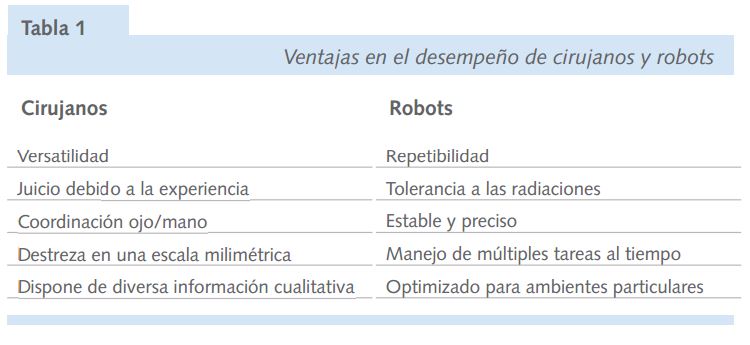
Robots have many advantages over humans when carrying out manipulation tasks. Their precision and repeatability have enabled them to enter industry readily, bringing clear economic benefits. In surgery, however, the working environment is far less structured than in industry, presenting problems such as the loss of haptic feedback and a lack of adaptability.
It must also be understood that it is not normally possible to programme a robot to perform a surgical task autonomously. Robots should therefore be seen as an ‘extension or enhancement of human capabilities’, rather than a replacement for the human operator, as commonly occurs in industrial automation. Tables 1 and 2 summarise the strengths and weaknesses of robots and humans in surgery.
Retinal repair surgery illustrates how humans and robots can work together. This operation requires a laser to be positioned precisely within a radius of 25 cm of the target to avoid damaging the blood vessels supplying the retina. A human hand cannot control a surgical instrument at distances of less than 100 cm from its target. Furthermore, as surgeons tire, tremor appears and necessarily reduces precision. Finally, the eye naturally moves at 200 Hz, making it a moving target (Satava, 1998). These factors combine to create an operating situation that cannot provide the required accuracy, but lies comfortably within robots' technological capabilities. Integrating the robot with a computer allows the eye's movement to be fixed within a reference frame so that it appears stationary, while the surgeon's tremor can be filtered out. The result is a system capable of positioning the laser with an accuracy of 10 cm — ten times less than a human hand without robotic assistance.
To fully develop this promising technology, however, communication and mutual understanding between surgeons, engineers, business leaders and healthcare administrators are vital. On the medical side, this must begin with an open mind and a willingness to seek solutions in new technologies.
Models of surgical robots:
Aesop.
This was the first robot for surgical applications commercially available in the United States, in 1994. The Aesop robot moves an endoscope (video camera) inside the human body during laparoscopic operations and is controlled by the surgeon's voice (Stoianovici, 2000). This gives the surgeon greater freedom of movement, focusing attention on the desired area through spoken commands to the robot. However, the robot's task does not involve active invasive manipulation inside the human body.
NeuroMate.
Its function is to determine the insertion point for a guide in neurosurgical operations, based on pre-operative images (Varma et al., 2003). This robot is the successor to the Puma that performed the first such operation in 1985.
Zeus and Da Vinci.
These are two teleoperated systems with common characteristics: the surgeon sits comfortably at a console, viewing a three-dimensional image of the patient on a screen and operating two haptic master instruments that move two slave surgical instruments inside the patient (Clearly and Nguyen, 2001). The Zeus robot has six degrees of freedom (Marescaux and Rubino, 2003), while the Da Vinci system has seven (Guthard and Salisbury, 2000). The respective manufacturers merged in 2003, and Da Vinci is the system still marketed (Curley, 2005).
Robodoc.
In 1992, IBM and partner companies developed this robot for orthopaedic operations (Bauer et al., 1999), aligning the femur and prosthesis during knee replacement procedures. The system comprises three parts: the robot itself, a trajectory planning station and the computer that guides and controls the robot (Clearly and Nguyen, 2001).
Acrobot.
Developed in the United Kingdom for total knee replacement (Jacopec et al., 2001), it comprises a drilling instrument with motors whose movements are restricted to a specific area defined by pre-operative images. This allows surgeons to feel the forces involved in drilling directly, while protecting other regions from the drill's effects.
CyberKnife.
This robot is used to irradiate a wide variety of tumours. The procedure begins with images obtained through a computed tomography system, which provide input to a trajectory planner that generates spatial commands for the linear accelerator mounted on the robot (Nathoo et al., 2003). The robot is fully autonomous during the radiation phase, achieving high precision and avoiding damage to healthy cells. Figure 4 shows this type of robot in its operating theatre (CiberKnife, 2006).
To give an idea of the cost of these robots, a Da Vinci costs approximately 1.25 million dollars, with an additional annual maintenance cost of 10%. Instruments must also be replaced every 10 operations, adding another 2,000 dollars to the cost (Hanley and Talamini, 2004). Figure 5 shows a Da Vinci robot's console and operating theatre setup (Intuitive Surgical, 2006).
Also noteworthy is the extraordinary cholecystectomy (gallbladder removal) performed in 2001 by Dr Marescaux using a Zeus robot, with the surgeon in New York and the patient in Strasbourg, France (Marescaux et al., 2001). This intervention opened up new possibilities for surgical robotics and demonstrates its tremendous future potential.
Surgical simulator.
Surgical simulation reproduces the visual and tactile sensations experienced by a surgeon during an operation using a computer and a robotic system (Delinguette and Ayache, 2004). Medical interest in this technique is linked to the development of minimally invasive surgery, especially video-assisted surgery (endoscopy and laparoscopy).
Simulators can be viewed as systems operating similarly to Zeus and Da Vinci robots: the trainee surgeon sits at a computer screen operating two haptic interfaces, devices that provide sensory feedback. The computer contains models of organs involved in particular surgical operations. The surgeon can handle these two interfaces as though they were surgical instruments, immersed in a virtual environment with as much detail as possible. Note the similarity to the robots described: instead of a real robot, there is a virtual system modelled on a computer. The simulator's advantages over commonly used training methods involving animals and cadavers are worth noting (Delingette and Ayache, 2005; Haptica, 2006).
Conclusions
Robotics has revolutionised industrial production and is beginning to make extraordinary contributions to medicine. The day may not be far off when someone with a leg or hand amputation can regain all lost functionality, performing daily tasks naturally and ‘feeling’ the artificial organ as though it were their own limb. The tremendous social importance of this research should be emphasised.
Another interesting application is robotics in surgical assistance, where the aim is not to replace surgeons but to enhance and improve their performance. Surgical simulators are more immediately applicable in our setting, training new surgeons and providing a bridge towards surgical assistants themselves.
Oscar Andrés Vivas Albán
(www.ai.unicauca.edu.co) Industrial Automation Group, Faculty of Electronic Engineering and Telecommunications.